Korean Convenience Store Words: Your GS25, CU and 7-Eleven Survival Guide
The questions the cashier will ask at a Korean convenience store, the words on the shelves, and what to say back, with audio.
If there's one place you'll visit every single day in Korea, it's the convenience store. There's one on almost every block, they're open 24 hours, and the food is honestly good. The checkout takes ten seconds, but the cashier will ask you two or three quick questions in Korean. Here's how to understand them and answer like you've done it a hundred times.
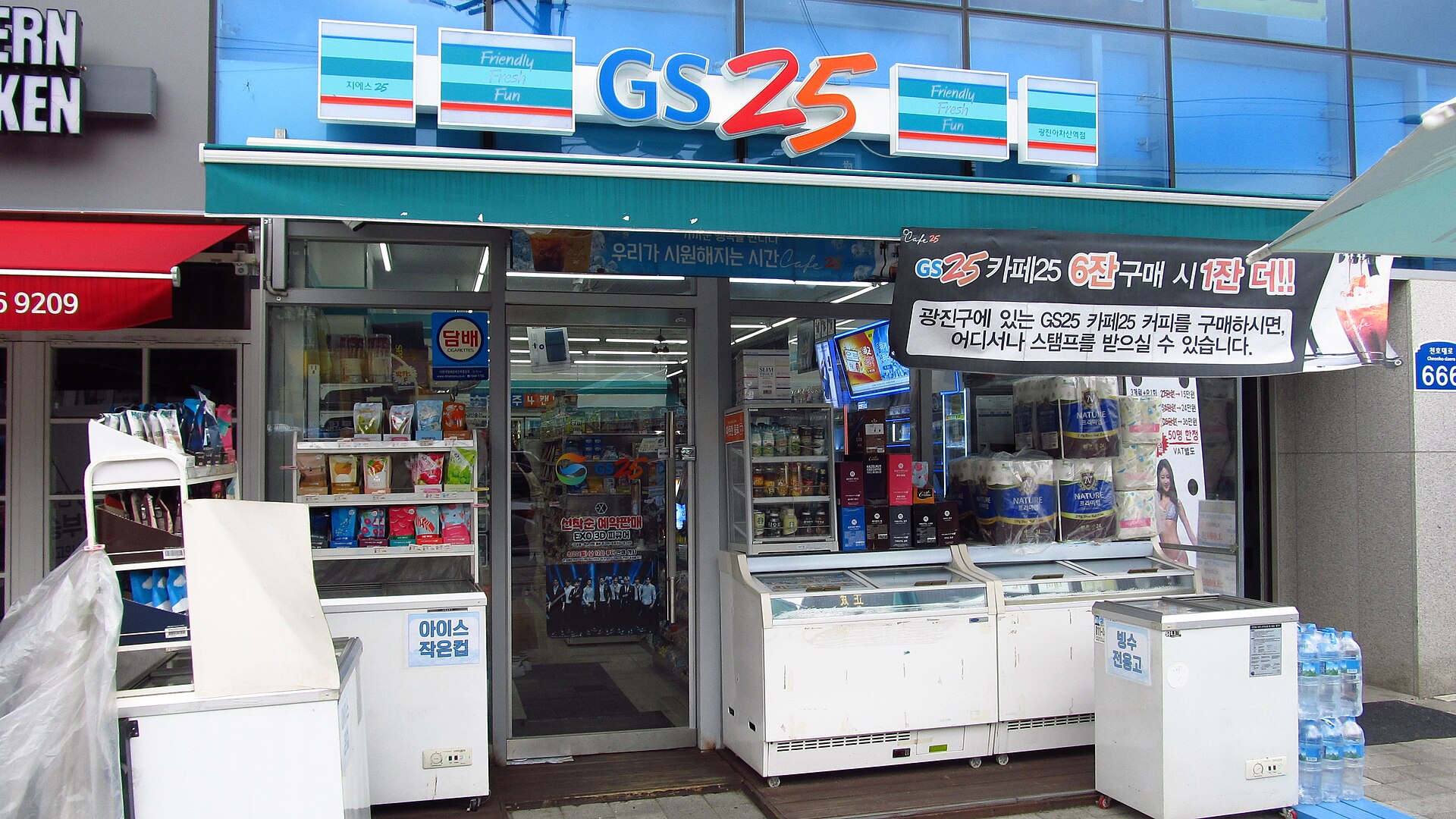
Quick test: which store is this?
Show the answer
It's GS25. The big four chains are GS25, CU, 7-Eleven and emart24. In Korean, a convenience store is 편의점 (pyeon-ui-jeom). Ask "편의점 어디예요?" and anyone can point you to the nearest one.
The 3 questions at the counter
| The cashier says | Meaning | Easy answer |
|---|---|---|
| 봉투 필요하세요? | Do you need a bag? | 네 (yes) / 괜찮아요 (I'm fine) |
| 데워 드릴까요? | Shall I heat it up? | 네, 데워 주세요 |
| 영수증 드릴까요? | Do you want the receipt? | 괜찮아요 |
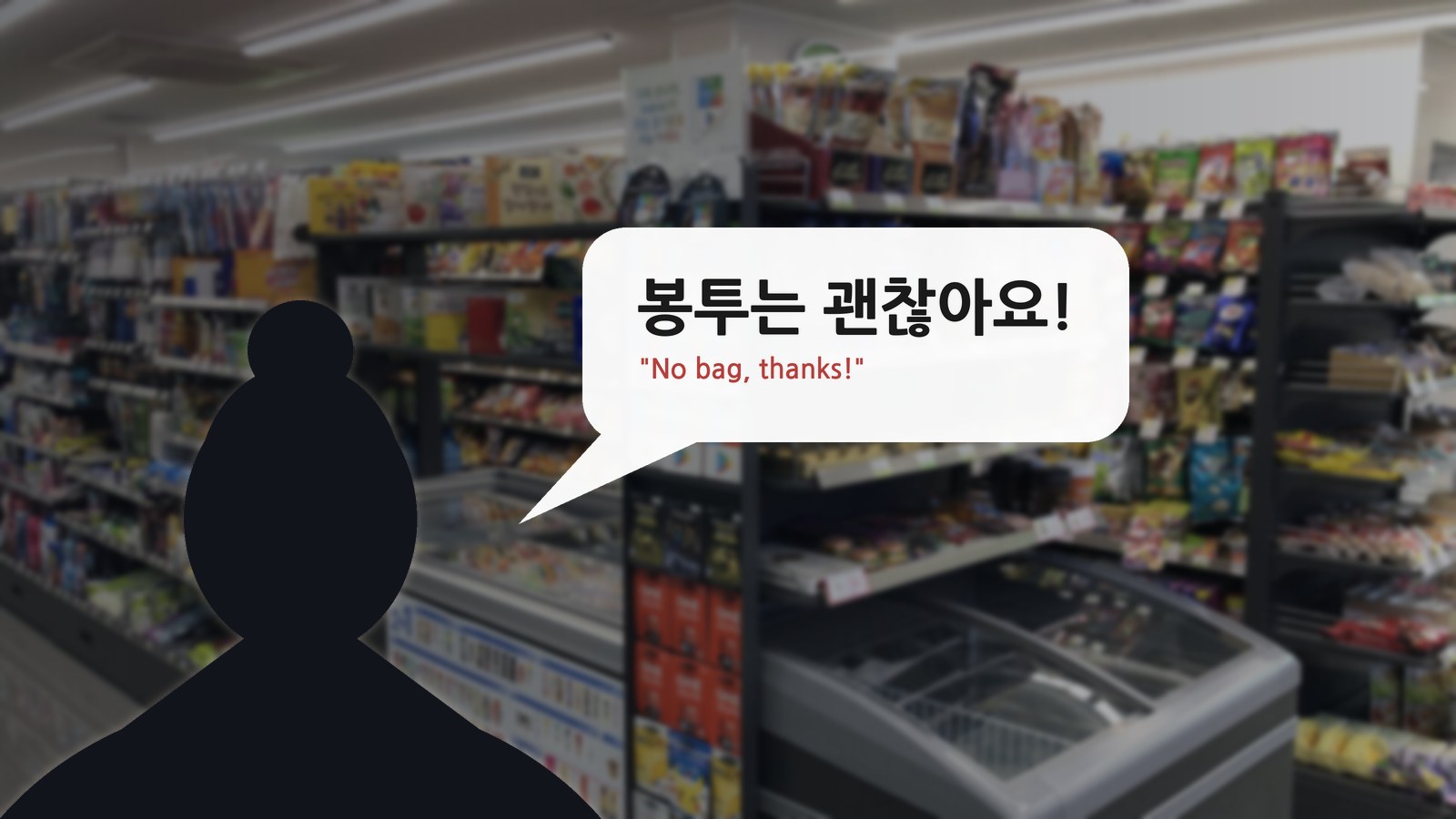
Bags usually cost a little extra, which is why they ask. 괜찮아요 (gwaen-chan-a-yo) literally means "it's okay", and it's the politest way to say "no thanks" in Korea. You'll use it everywhere.
봉투는 괜찮아요.
bong-tu-neun gwaen-chan-a-yo "No bag, thanks."
데워 주세요.
de-wo ju-se-yo "Please heat it up."
영수증은 괜찮아요.
yeong-su-jeung-eun gwaen-chan-a-yo "I don't need the receipt."
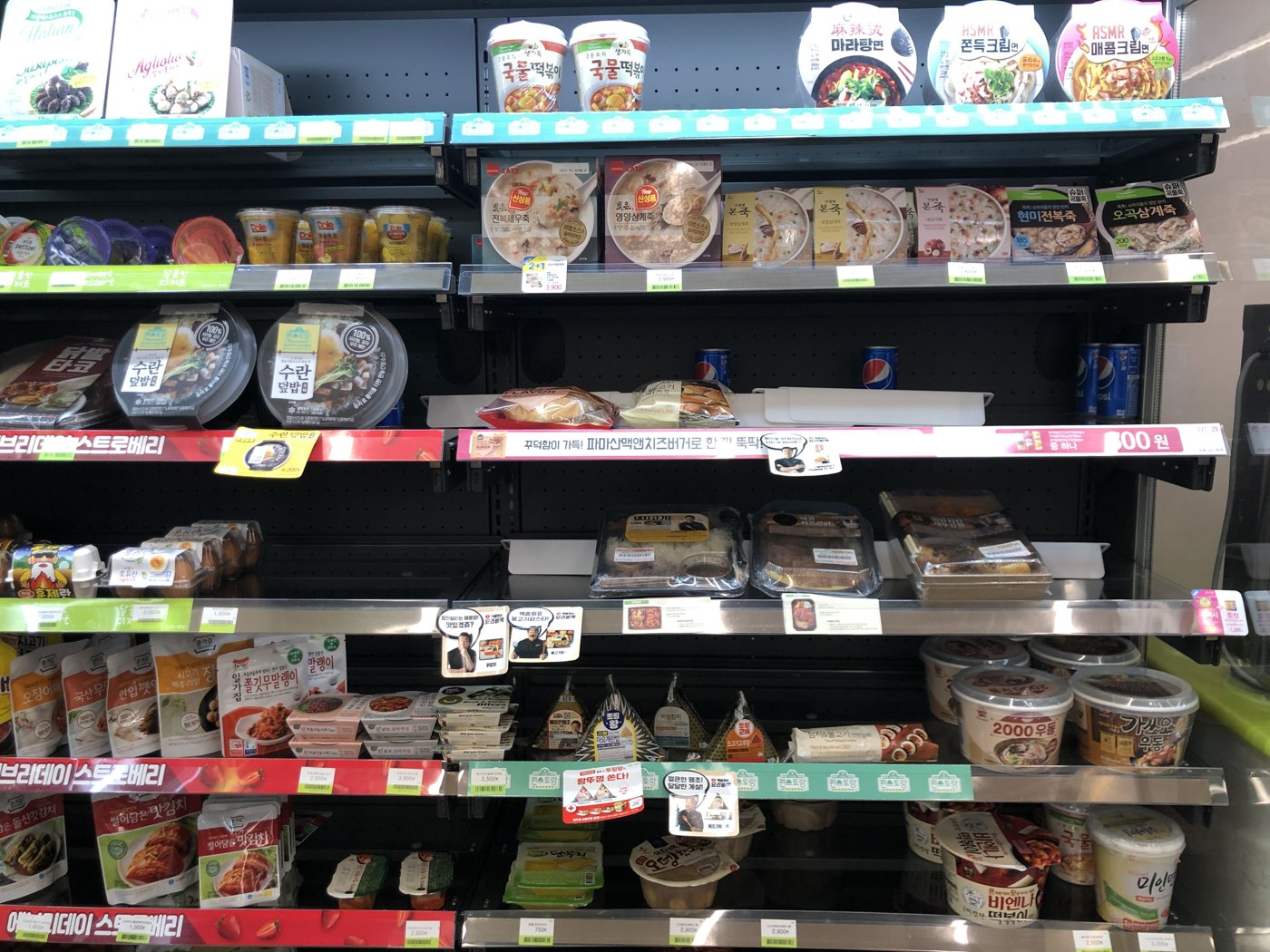
What's on the shelves
| Korean | Romanization | What it is |
|---|---|---|
| 삼각김밥 | sam-gak-gim-bap | triangle rice ball wrapped in seaweed |
| 도시락 | do-si-rak | lunch box |
| 컵라면 | keop-ra-myeon | cup ramen |
| 바나나맛 우유 | ba-na-na-mat u-yu | banana milk |
| 온수 | on-su | hot water (for your ramen) |
| 전자레인지 | jeon-ja-re-in-ji | microwave |
Notice how many you can already guess? 컵라면 is literally "cup ramyeon", and 바나나 is banana. Same trick as the cafe menu: lots of Korean is English in disguise.
The deal stickers: 1+1 and 2+1
You'll see bright stickers that say 1+1 or 2+1. They mean exactly what they look like: buy one, get one free, or buy two, get a third free. If you bring one 1+1 drink to the counter, the cashier might say 하나 더 가져오세요: "Go grab one more!"
Mini quiz
1. The cashier asks 봉투 필요하세요? and you don't want a bag. What do you say?
괜찮아요 (gwaen-chan-a-yo). Or the full version, 봉투는 괜찮아요.
2. You want your lunch box warmed up. What do you say?
데워 주세요 (de-wo ju-se-yo).
3. Read this out loud: 컵라면
keop-ra-myeon: cup ramen!
Why this matters more than it seems
Convenience stores are where most travelers have their very first real exchange in Korean. Getting through it smoothly on day one is a confidence boost that makes you want to try again at the cafe, the taxi, the market. Every word above uses only the 40 letters of Hangul, and my 7-day workbook teaches all of them with real words like these.
Next up: how to use a T-money card, which you can buy at the same counter.
Free download
The Seoul Cheat Sheet
Ten signs, eight cafe words and six travel phrases on two printable pages. Tell me where to send it.
From the author
Learn to Read Korean in 7 Days
A printable, step-by-step workbook that takes you from your very first letter to reading a real cafe menu and Seoul signs. Numbered stroke order, a memory trick for every letter, and real words from Day 1.
See the workbookEmma is a Korean-American who grew up in the US and now lives in Seoul. A marketer by trade, she spent years guiding first-time visitors around Korea and teaching them to read Hangul.