Learn Hangul: The Korean Alphabet for Beginners (Read Your First Words Today)
Hangul has only 40 letters and was designed to be easy. Learn how it works, the 5 letters to start with, and read your first real Korean words in 10 minutes.
Every visitor I've helped said the same thing on day one: "Korean letters look impossible." By day three they were reading cafe menus out loud. Hangul isn't hard. It was literally designed to be easy, and in this post you'll read your first real words.
Why Hangul is easier than it looks
In 1443, King Sejong created Hangul so that ordinary people, not just scholars, could read and write. It was announced to the public in 1446 with a famous line: a wise person can learn it in a morning, and even a slow learner can learn it in ten days. Koreans still celebrate Hangul Day every October 9.
Three things make it easy:
- It's an alphabet. Like English, each letter is one sound. There are no thousands of characters to memorize.
- The shapes have logic. Many consonants are drawn after the shape your mouth makes. ㄴ (n) is the tongue touching behind your teeth. ㅁ (m) is your closed mouth.
- There are only 40 letters. 19 consonants and 21 vowels, and many of those are just doubles or combinations of the basic ones.
Letters stack into blocks
This is the one idea that unlocks everything. Korean letters aren't written in a long line. They're grouped into blocks, one block per syllable.
| Letters | Block | Sound |
|---|---|---|
| ㄴ + ㅏ | 나 | na |
| ㅁ + ㅜ | 무 | mu |
| 나 + 무 | 나무 | na-mu (tree) |
Vertical vowels like ㅏ go on the right. Flat vowels like ㅜ go underneath. That's the whole rule for now.
Your first 5 letters
| Letter | Sound | Memory trick |
|---|---|---|
| ㄱ | g / k | A gun pointing down |
| ㄴ | n | Your tongue tip nudging the back of your teeth |
| ㅁ | m | A closed mouth |
| ㅏ | a | A person pointing to the right: "ah, over there!" |
| ㅜ | u | A table with a leg pointing down: "oo, under the table" |
Read your first words
Cover the right column and try each one out loud. You know all the letters already.
| Word | Say it | Meaning |
|---|---|---|
| 나 | na | me / I |
| 무 | mu | radish |
| 나무 | na-mu | tree |
| 가구 | ga-gu | furniture |
| 누나 | nu-na | older sister (what a boy calls her) |
What comes next
Those 5 letters are about one eighth of the alphabet. The rest follow the same patterns:
- More consonants like ㅅ (s), ㅇ (silent at the start, "ng" at the end) and ㅎ (h).
- More vowels that are mostly the ones you know, plus a stroke. ㅏ is "a", and ㅑ with an extra line is "ya".
- A letter at the bottom of a block, like the ㄴ in 안 (an).
With those, you can read 안녕하세요 (here's how to say it), the signs in the Seoul subway and almost everything on a cafe menu.
Learn the rest in 7 days
I made a printable workbook that does exactly what this post did, for all 40 letters. A few letters a day, numbered stroke order, a memory trick for each one, and real words to read from Day 1. By Day 7 you're reading a real Seoul cafe menu.
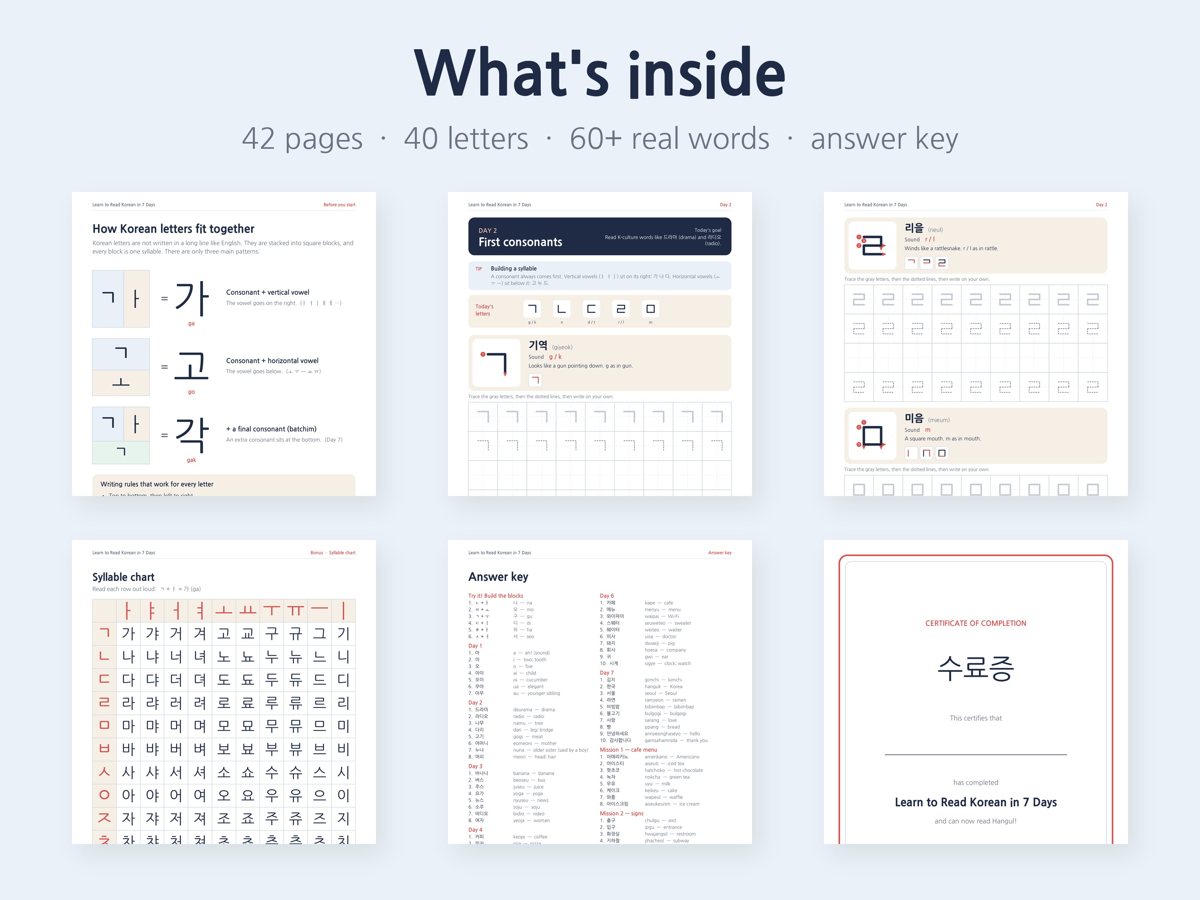
Printable on Etsy
Learn to Read Korean in 7 Days
The rest of the alphabet, one day at a time. Numbered stroke order, a memory trick for every letter, and real Seoul words to read from Day 1.
See inside the workbookMini quiz
1. How many letters does Hangul have?
40: 19 consonants and 21 vowels.
2. Read this: 나무
na-mu, "tree".
3. Where does the vowel ㅜ go in a block, on the right or underneath?
Underneath, like in 무. Flat vowels go under the consonant.
4. Who created Hangul?
King Sejong, in 1443. His statue stands in Gwanghwamun Square in Seoul.
Free download
The Seoul Cheat Sheet
Ten signs, eight cafe words and six travel phrases on two printable pages. Tell me where to send it.
From the author
Learn to Read Korean in 7 Days
A printable, step-by-step workbook that takes you from your very first letter to reading a real cafe menu and Seoul signs. Numbered stroke order, a memory trick for every letter, and real words from Day 1.
See the workbookEmma is a Korean-American who grew up in the US and now lives in Seoul. A marketer by trade, she spent years guiding first-time visitors around Korea and teaching them to read Hangul.